
Choose whether to load saved clients from a previous session or start with a clear client bar.
In thick-wall construction there’s often no wood jamb or casing — the drywall wraps into the opening. Paper has to cover those returns: three sides on a door (both jambs + head) and four on a window.
Tap an image to enlarge.
Turn this on when drywall returns wrap into doorways, windows, fireplaces, TV boxes, or other openings. Uncheck any individual feature that does not need wrapping.
Measure the return depth from the wall face to the frame or recessed edge and enter it as the default; any single opening can override it. The return depth combines with the cut margin.
Cut margin is a room-wide framing allowance applied to every wrapped feature; it has no per-opening override.
Where it’s most common
Storm-code and masonry (CMU / block) regions — Florida especially, plus the Gulf and Southeast coast: Texas (coastal), Louisiana, Mississippi, Alabama, Georgia, South Carolina, North Carolina; and Southwest block / stucco: Arizona, New Mexico, Nevada.
Also seen, but less common
High-performance, ICF, and cold-climate builds — California, Washington, Oregon, Colorado, Minnesota, and the Northeast (Massachusetts, New York, Vermont, Maine, New Hampshire, Connecticut, Rhode Island).
In the estimate this adds pattern-matched wrap pieces and a configurable wrap fee per opening; long-run strips are unaffected.
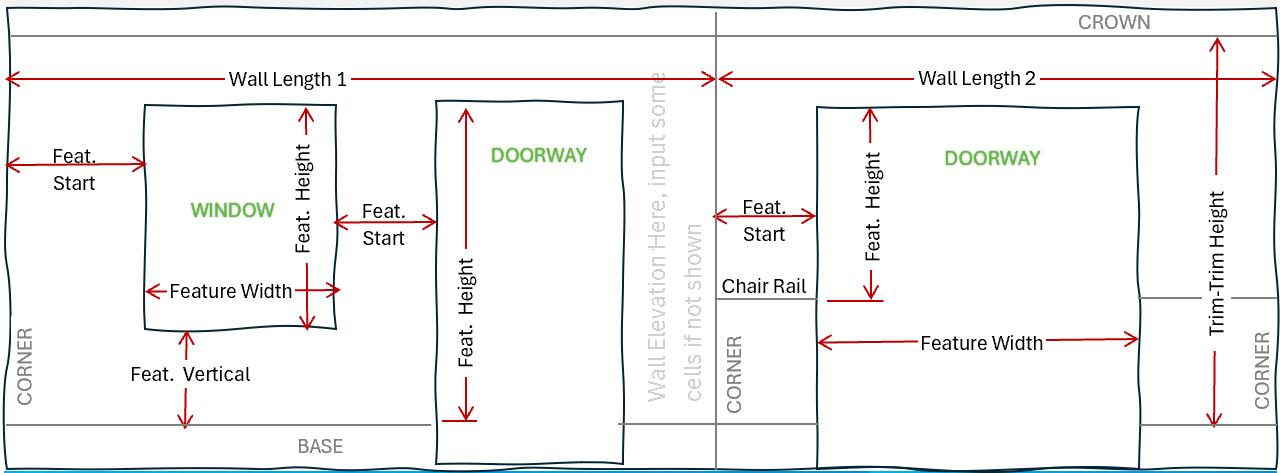
Wall Length: Measure along the base trim from corner to corner.
Trim-to-Trim Height: Measure from base trim to top trim (or ceiling if no trim).
Features: Add doors, windows, and openings with their start, width, and height.
| Area | Linear In | Labor Total (RPLI) | Change | Qty Order | Roll Length | Trimmed Width | Vert. Repeat | Pre-trimmed | Room Name | Selection Link | Export |
|---|
Loaded wallcovering image
Choose how to initialize the new room.
Continue to the next tab?